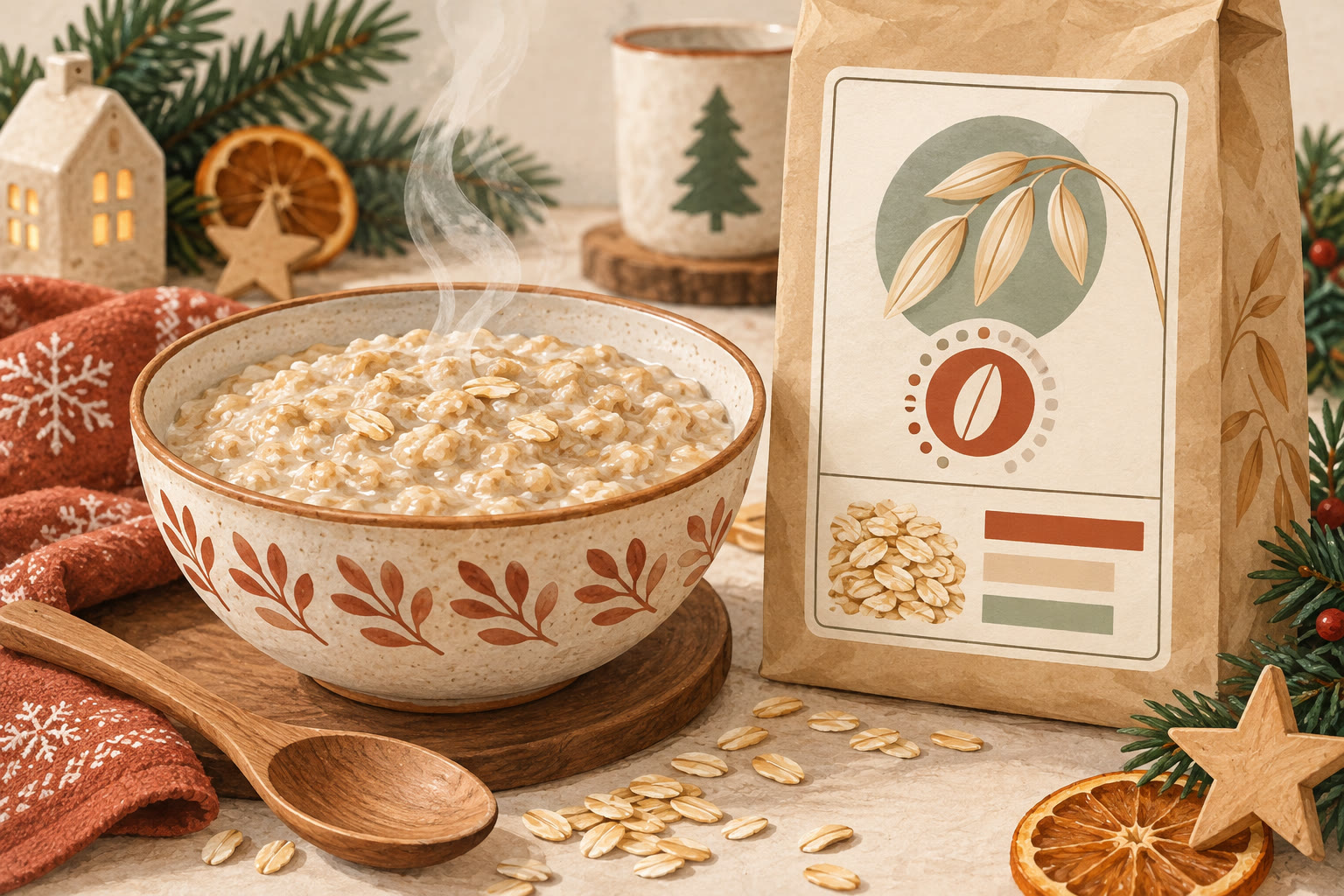
A gluten-free oat label must show two things: a gluten-free claim, meaning the product contains no more than 20 parts per million of gluten, and oats named and emphasised as an allergen in the ingredients list, because the law requires this regardless of the gluten-free claim. Both can sit on the same pack because they answer different questions: the claim is about the gluten content, the emphasis just tells you oats are present.
For anyone managing coeliac disease, that distinction matters. Most people with coeliac disease can tolerate gluten-free oats, but a small minority may still react. Here's how I'd separate the packet information from the questions that need a conversation with your GP or dietitian.
What gluten-free must mean on an oat label
In the UK, a product may be labelled gluten-free only if it contains no more than 20 parts per million (ppm) of gluten. That is the legal threshold explained by Coeliac UK’s gluten-free labelling guidance and the NHS guidance on treating coeliac disease.
The wording has a defined meaning. It isn’t simply a description chosen because the main ingredient is oats, or because the product looks like something that ought to fit a gluten-free diet. Coeliac UK says uncontaminated oats that test at 20ppm or less may carry the gluten-free label.
That gives us a practical starting point: choose oats specifically labelled gluten-free. I wouldn’t substitute a guess based on the product’s name, a plain-looking ingredients list or the fact that oats themselves don’t naturally contain gluten.
The same distinction matters when oats appear in another food. Seeing oats among the ingredients does not, by itself, establish that the product qualifies as gluten-free. Look for the gluten-free wording on the product you’re actually considering, rather than assuming that every oat-based food has the same status.
There’s also a limit to what that wording promises. It establishes compliance with the gluten threshold; it does not promise that every person with coeliac disease will tolerate the oats. I’ll come back to that, because it’s the part that a perfectly clear packet still cannot settle.
Why ordinary oats are usually unsuitable
Oats do not naturally contain gluten. The difficulty with standard oat products is contamination with wheat, barley or rye. Coeliac UK’s oats guidance explains that ordinary oat products are often unsuitable because they are produced in the same places as those other grains.
So “oats don’t contain gluten” is only part of the answer. It describes the oats themselves, without answering what may have reached them during production and handling. A packet of ordinary oats and one specifically labelled gluten-free cannot be treated as interchangeable on that basis.
I find it helpful to keep the distinction very plain: being an oat product is not the same thing as being a gluten-free oat product. For a gluten-free diet, the NHS advises choosing only oats specifically labelled gluten-free.
Food preparation matters after the packet is opened, too. The NHS says cross-contamination can happen when gluten-free foods and foods containing gluten are prepared together or served with the same utensils. Its advice is to avoid this during preparation.
For an oat-based breakfast, that means paying attention to the preparation and serving utensils as well as the packet. A gluten-free label answers a question about the product; it cannot prevent gluten being transferred in the kitchen afterwards. I’d keep both checks in mind, without turning breakfast into a detective assignment.
Why oats must still be emphasised as an allergen
Even on a certified gluten-free product, oats must still be named and emphasised as an allergen in the ingredients list. Coeliac UK’s labelling guidance makes this requirement explicit. The gluten-free claim does not remove it.
Under UK law, oats are treated as an allergen because of the contamination risk from gluten-containing cereals and because they contain a protein called avenin. That is why you can legitimately see a gluten-free claim alongside emphasised oats.
The emphasis might be bold type. Whatever the presentation, its presence is not, by itself, evidence that the gluten-free claim is wrong. Both pieces of information belong there, and both serve a purpose.
I’d read them as two separate statements: this product meets the gluten-free threshold, and this product contains oats. You don’t need to choose which statement to believe. The apparent contradiction disappears once you know that the ingredients requirement still applies.
This is especially useful if you’ve been rejecting every gluten-free packet with oats in bold, or overlooking the ingredient because the front says gluten-free. Read the claim and the ingredients together. Then keep your own professionally advised dietary needs in the picture.
What the label cannot tell you about tolerance
Oats contain avenin, a protein similar to gluten. According to Coeliac UK, most people with coeliac disease tolerate gluten-free oats without problems, but a very small number may be sensitive to them. The NHS also recognises that avenin may trigger symptoms in a few people.
That means ongoing symptoms deserve attention even when the oats are correctly labelled gluten-free. It also means that someone else’s difficulty with oats does not establish how you will respond. Neither a reassuring packet nor another person’s experience can provide an individual answer.
On timing, Coeliac UK says gluten-free oats can be introduced at any stage of the gluten-free diet, including at diagnosis. There is no blanket waiting period in that guidance for me to pass on here.
If you have ongoing symptoms or concerns, Coeliac UK advises reviewing oat use with your health professional, who can monitor you and give specific advice. A GP or dietitian is the right person for that conversation. The NHS says people newly diagnosed with coeliac disease are referred to a dietitian for support.
I’d take the packet details and your questions to that appointment: are these oats appropriate for my diet, and does my response need review? Keep the label check straightforward, and let individual advice answer what the label cannot.
Nora is our brand character. Health information is sourced separately and should support conversations with your care team, not replace them.