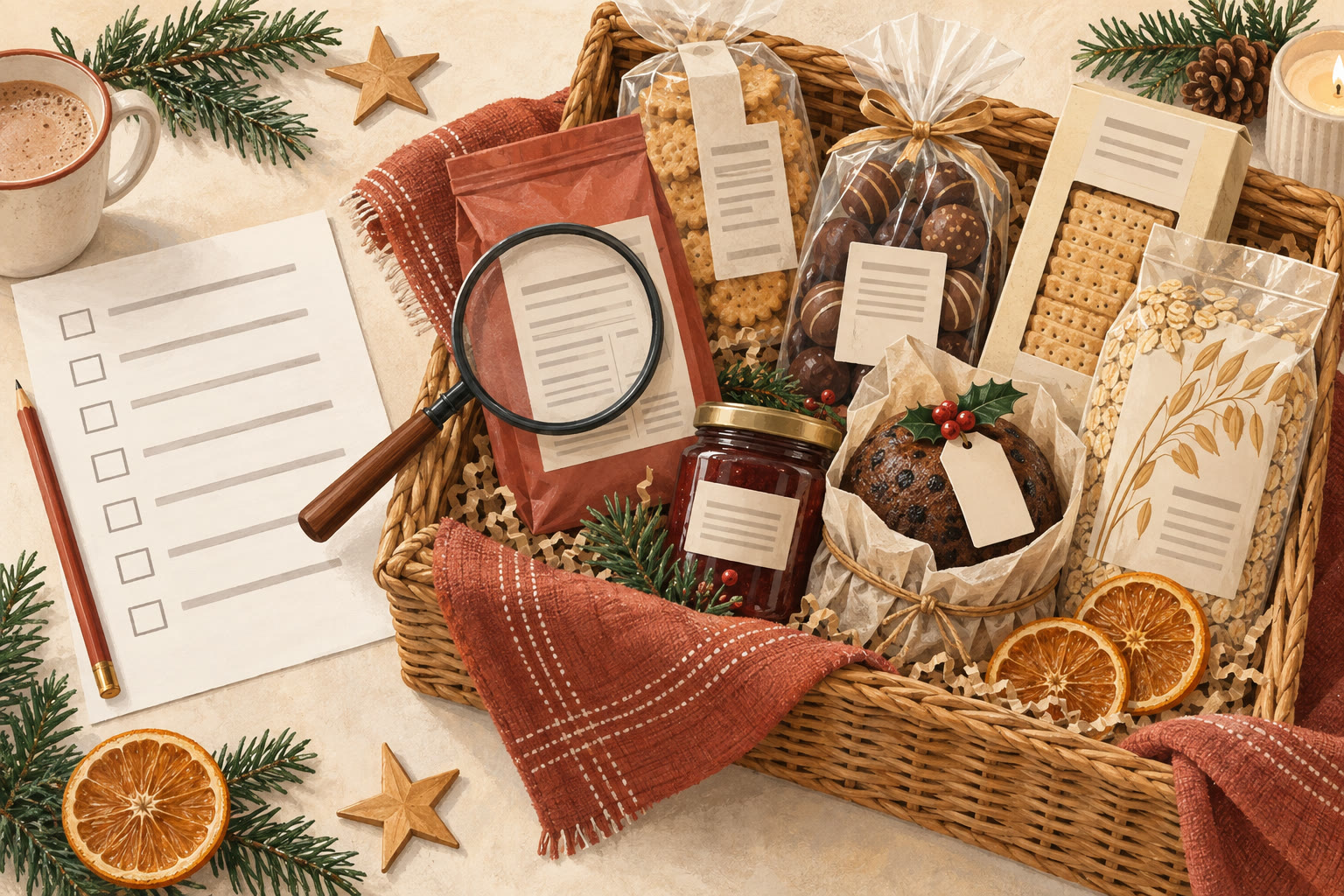
To check a gluten-free Christmas food gift before buying, read the product's own gluten-free label and its full ingredients list, then look separately for any precautionary "may contain" warning and check the actual pack itself. By law, food labelled gluten-free can contain no more than 20 parts per million of gluten, and any cereal containing gluten must be highlighted in the ingredients list, so the ribbon can wait while I read the packet.
The tempting shortcut is to assume that a familiar packet, a festive hamper description or a reassuring photograph tells you everything. I'd check the exact food being sold, including its full ingredients and any warnings. Here's the order I'd follow before putting it in the basket.
1. Start with the person receiving it
Before choosing the food, I’d ask what the recipient actually enjoys and whether there are other ingredients they need to avoid. A gluten-free label answers a particular question about gluten; it doesn’t tell you someone’s preferences or all their dietary requirements.
You can ask without revealing the whole present: “I’m thinking of a food gift. Is there anything you’d like me to check or leave out?” If they have a particular approach to precautionary warnings, ask about that too. I’d rather spoil a tiny corner of the surprise than hand over something they feel obliged to accept but cannot confidently eat.
For a mixed gift, make a list of every food included before deciding. A description that draws attention to one gluten-free item doesn’t answer the questions about everything beside it. Each packet needs its own check, including any small extras tucked into the presentation.
This also gives you a useful stopping point. If you cannot establish what is included or whether it suits the recipient’s needs, leave the purchase undecided. There’s no need to fill an information gap with Christmas optimism.
What do the gluten-free label and ingredients list actually tell you?
First, look for the wording “gluten-free” on the actual product. The NHS explains that, by law, food labelled gluten-free can contain no more than 20 parts per million (ppm) of gluten. That is a defined limit, rather than a promise of absolute zero.
Then turn to the ingredients. According to Coeliac UK’s guide to reading food labels, UK allergen labelling law requires cereals containing gluten to be emphasised in the ingredients list, for example in bold. The specific cereal must be named, rather than hidden behind a generic description.
Look for wheat, rye, barley, oats, spelt and Khorasan wheat. I’d use the emphasised words to help navigate the label, then read the full list. The NHS highlights that processed foods can contain gluten through ingredients such as malt flavouring and modified food starch, which is why the front of the packet cannot do all the work.
That doesn’t mean every unfamiliar ingredient name is a reason to reject a gift. Coeliac UK specifically explains that wheat-based maltodextrin does not need to be listed as an allergen because gluten is removed during processing. I wouldn’t invent a blanket rule that every wheat-derived ingredient means the same thing.
If an ingredient leaves you unsure how to interpret the product’s labelling, ask the manufacturer about the exact item before buying. Send the product name and the wording that needs explaining. A clear question is much more useful than asking whether an entire range is “fine”.
Give oats their own check. The NHS says oats do not naturally contain gluten, but contamination is a concern and only products labelled gluten-free should be chosen. If the gift contains oats, look for explicit gluten-free labelling; ordinary oats are not something I’d assume suitable for a coeliac recipient.
What does a 'may contain' warning mean on a gluten-free label?
Once you’ve read the ingredients, look for wording such as “may contain wheat” or “made on a line handling wheat”. Coeliac UK describes these as voluntary manufacturer warnings about possible cross-contamination. They are separate from the declaration of ingredients deliberately used in the food.
A warning does not say that wheat is definitely present in every packet. Equally, it is not a guarantee of absence. Because these statements are voluntary, I wouldn’t treat the lack of one as a separate assurance that cross-contamination cannot happen.
For a coeliac recipient, weigh any warning before committing to the gift. If you’re uncertain, check the exact combination of ingredients, gluten-free wording and precautionary statement with the manufacturer, and ask the recipient whether it meets their needs. Don’t decide on their behalf that a small-print warning probably doesn’t matter.
I’d keep that conversation practical: “This is the label, and this is the warning. Would you be comfortable receiving it?” Send a readable photograph or the complete wording. A cropped picture of the cheerful front panel leaves out the very information they need.
What should you check on the actual pack before buying?
Before paying, inspect the packaging as well as the words. I’d want the food’s original wrapping intact, with readable ingredients and warnings. If a seal looks broken or the label is missing, I’d choose another pack or ask the seller to resolve it before buying.
For an online order, check that the listing identifies the exact version and contents currently offered. Can you read the ingredients photograph? Does it match the item selected? Are substitutions possible? If the answers are unclear, ask the seller for current details rather than relying on an older photograph or review.
Confirm current availability and the delivery information for your order too. I’m not confirming stock or delivery for any particular gift here. An earlier seasonal enquiry or request is not evidence that an item is now available, and a replacement item needs its own label check.
When the order arrives, read the actual packets again. Coeliac UK advises checking labels on every purchase because recipes and manufacturing processes can change without warning. Keep those labels with the gift so the recipient can make their own check.
My final pause would be simple: does it suit the person, have I understood the full label, and is this the exact, intact pack I checked? Once those questions are answered, the ribbon can have its moment.
Nora is our brand character. Health information is sourced separately and should support conversations with your care team, not replace them.