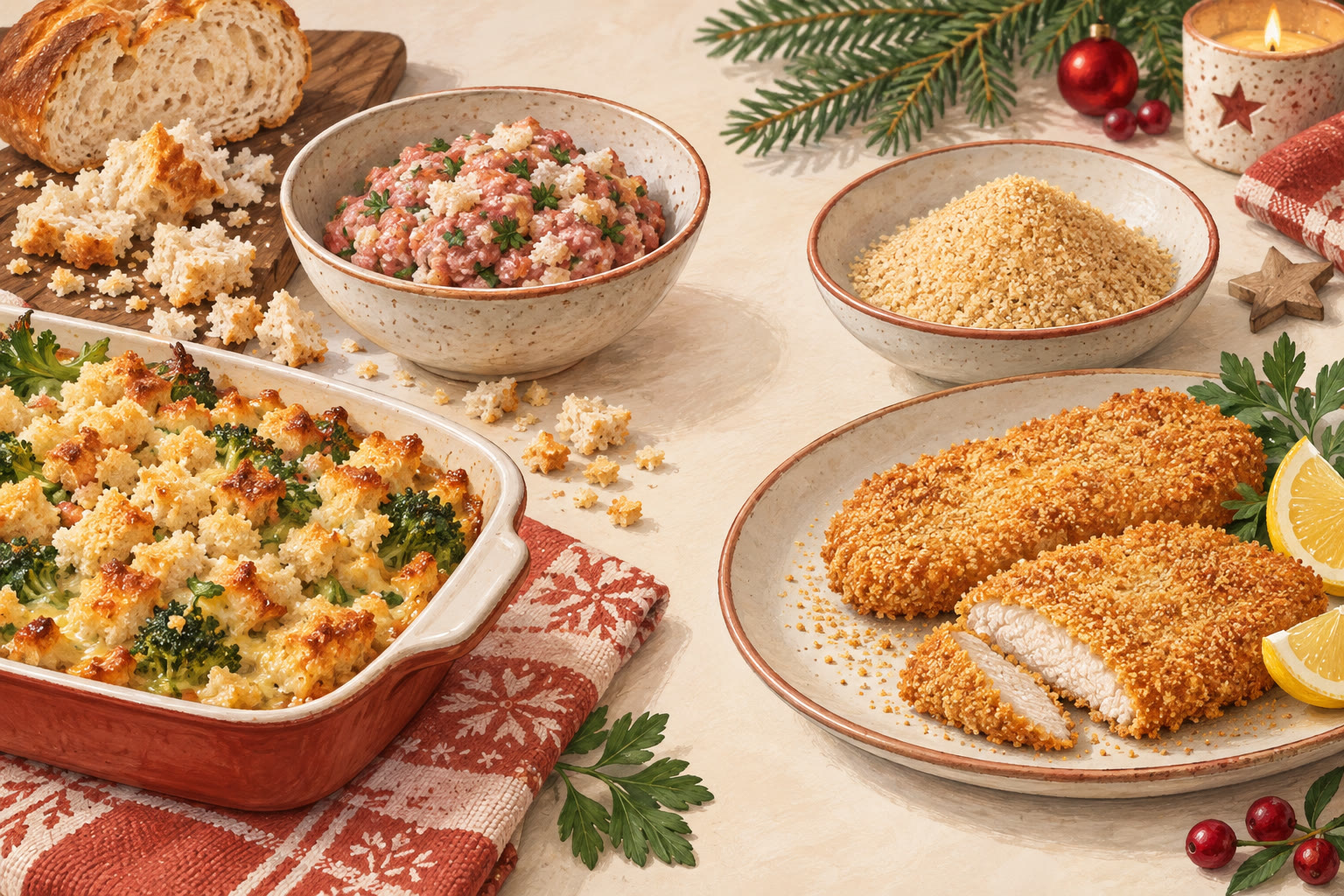
Dried breadcrumbs are the better choice for a thin, even coating, because their fine, uniform crumb browns more evenly. Fresh breadcrumbs work better in a mixture, such as a meatball, or as a scattered topping, because they hold onto more moisture and give more texture. Neither is better across the board: which one to use depends on the job the crumbs need to do.
For gluten-free cooking, there's also a separate question: whether the bread or crumbs are suitable in the first place.
Fresh or dried breadcrumbs: which should I use?
America’s Test Kitchen’s breadcrumb comparison describes fresh crumbs as coarser, lighter and more tender, with more moisture. Dried crumbs are finely ground, more uniform and lower in moisture. Those differences give us a useful starting point when a recipe leaves the format open.
This is general breadcrumb evidence, not UK-specific or gluten-free-specific testing. I haven’t kitchen-tested homemade gluten-free crumbs for this guide, so these are texture and moisture pointers, without preparation timings, temperatures or substitution ratios.
| What you need | Format to consider | Reason |
|---|---|---|
| A thin, even coating | Fine dried crumbs | Their uniform size gives a thinner, more even crust. Fresh crumbs brown more patchily because their pieces vary in size. |
| A mixture that binds and stays moist | Fresh crumbs | They absorb and retain moisture well. Dried crumbs do this poorly and are less suited to that role. |
| A scattered topping with texture | Fresh crumbs | Their size and moisture give useful texture. Dried crumbs alone can become sandy and dry rather than crunchy. |
The point I’d underline is that “dried” doesn’t automatically mean “crunchier”. It can describe the starting ingredient without promising the finish you want. Equally, the uneven pieces in fresh crumbs aren’t automatically a fault. They matter differently depending on where those crumbs end up.
If a recipe specifies a format, keep that choice: its other ingredients and method may depend on it. When it says only “breadcrumbs”, use the job in the table to make an informed starting choice.
Think about where the crumbs will sit
For a coating, I’d first decide whether I wanted a thin, even crust. That points towards fine dried crumbs in the general comparison. Their small, uniform particles explain the choice, rather than any claim that a particular packet is better.
Fresh crumbs bring a different result to a coating. Their uneven size means patchier browning, so they aren’t the obvious starting point when an even finish is your priority. That doesn’t make them useless; it gives you a clearer expectation before cooking.
Inside a meatball or meatloaf-style mixture, the question changes. You’re asking the crumbs to help bind the mixture and hold moisture, rather than create a surface crust. Fresh crumbs absorb and retain moisture well in that role. Dried crumbs perform poorly at retaining it in the cited comparison.
I wouldn’t choose dried crumbs for a mixture simply because “they’ll soak everything up”. That sounds plausible, but it isn’t what this evidence supports. The useful question is whether the ingredient helps the finished mixture stay moist and hold together.
For a scattered topping, fresh crumbs have size and moisture on their side. If you’re picturing distinct pieces across the top of a dish, that is the more relevant starting point. Fine dried crumbs alone can give a sandy, dry finish instead of the crunch you had in mind.
The word “alone” matters here. This comparison doesn’t establish how every topping containing other ingredients will behave. I’d use it to choose the crumb format, without turning it into a promise about a complete dish.
Are breadcrumbs gluten-free?
Texture can help you choose between formats, but it cannot tell you whether something is gluten-free. A coarse crumb and a fine crumb both need that separate check. I’d look for the gluten-free label on packaged crumbs, or on the bread intended for homemade crumbs.
Coeliac UK explains that, in the UK, a product labelled “gluten free” must contain 20 parts per million (ppm) of gluten or less. A separate “very low gluten” label applies to products made with gluten-free wheat starch containing between 21 and 100 ppm. Coeliac UK states that no products currently carry that label in the UK, although it may appear elsewhere in Europe.
The NHS describes coeliac disease as a condition in which eating gluten causes the immune system to attack the body’s own tissues, damaging the small intestine and impairing nutrient absorption. Gluten is found in wheat, barley and rye. There is no cure; a gluten-free diet is the standard way to control symptoms and prevent long-term complications.
That’s why I keep suitability and cooking performance as two distinct checks. A promising texture doesn’t answer the gluten question, and a gluten-free label doesn’t tell you which breadcrumb format will suit your dish.
How do you avoid cross-contamination with gluten-free breadcrumbs?
When handling gluten-free bread, the preparation space matters too. A suitable starting ingredient still needs care around gluten-containing crumbs.
Coeliac UK recommends toaster bags or a separate toaster for gluten-free bread products, and separate bread boards for gluten-free and gluten-containing bread. For butter, jam and other shared spreads, use separate condiments or clean cutlery each time to avoid crumb contamination. Hot soapy water or a dishwasher is enough to clean surfaces, pots, pans and utensils; separate cloths or sponges are not needed.
My starting question for your next dish is simple: are these crumbs coating, binding or topping? Choose the format around that answer, check gluten-free suitability, and give the preparation space the same attention. That makes “breadcrumbs” a much more useful instruction.
Nora is our brand character. Health information is sourced separately and should support conversations with your care team, not replace them.